


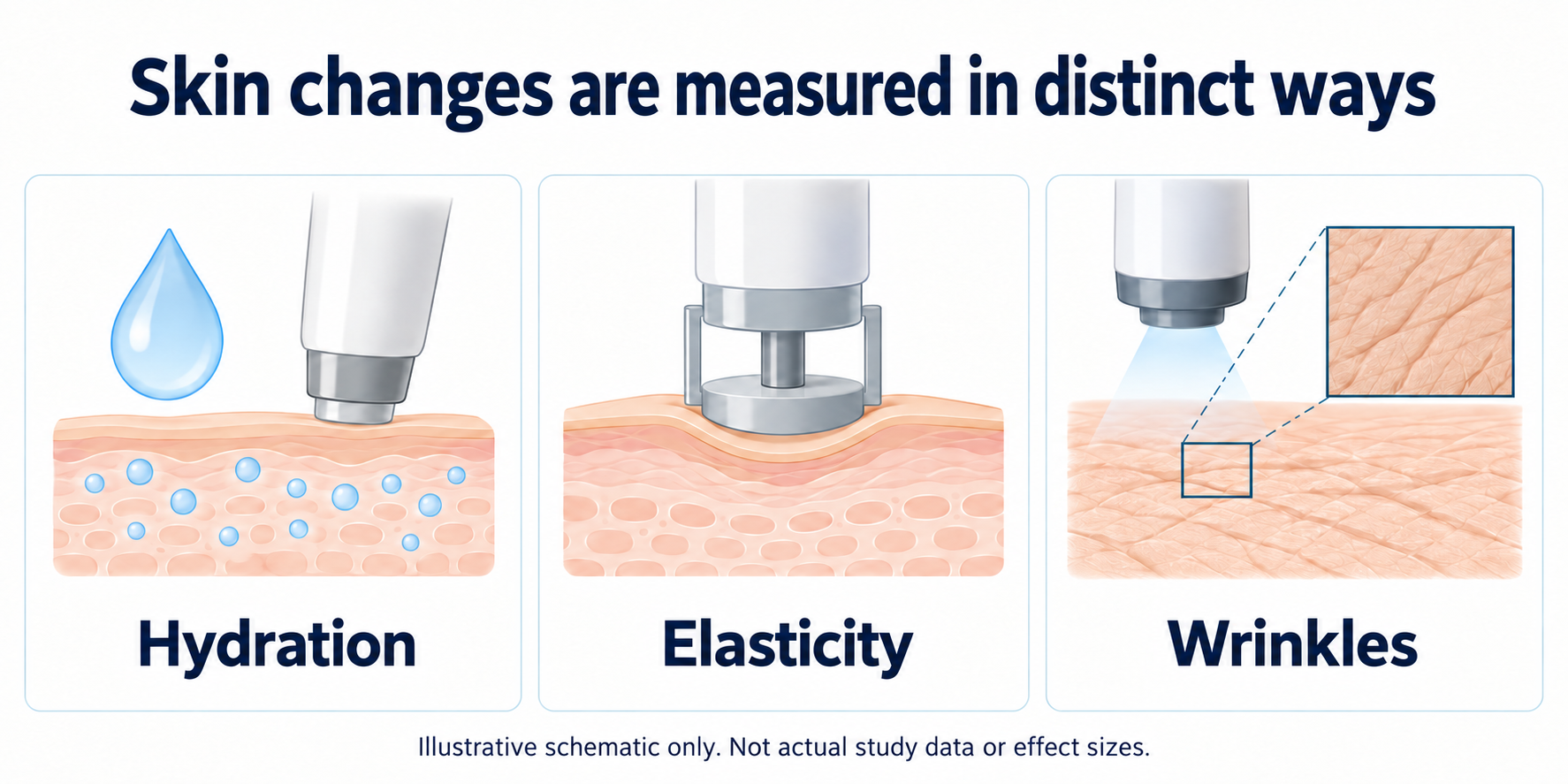
Some studies report better skin hydration and other measurements after people take oral collagen.
But the findings are not consistent across all studies. Current evidence does not show that people can reliably expect fewer visible wrinkles or a younger-looking appearance.
The question we reviewed
We focused on randomized trials of oral collagen peptides. In a randomized trial, participants are assigned by chance to different groups so the groups can be compared more fairly.
We also looked at reviews that combine results from several trials. We separated measured skin outcomes from certainty, practical meaning, and safety. This article does not decide whether a particular person should take collagen or how much to use.
Four evidence dimensions
- Direction: mixed. Some pooled analyses favor hydration, elasticity, and wrinkle measurements, but results change with study conditions and analysis.
- Certainty: low (qualitative editorial assessment). Many trials are small, short, and different from one another. This is not a formal GRADE assessment.
- Magnitude: unclear. It is not established whether the measured changes are noticeable in everyday appearance.
- Safety: limited evidence. Short trials cannot settle long-term safety or interactions. A case report describes a serious allergic reaction associated with fish collagen.
What studies observed
A 2025 review found pooled results favoring hydration, elasticity, and wrinkle measurements. However, the differences were not statistically clear in trials without pharmaceutical-company funding. The same was true in higher-quality trials.[1]
A result that is not statistically clear does not prove the effect is exactly zero. Funding category alone also cannot tell us whether an individual study is reliable.
A separate 2026 review reported favorable results for some instrument-measured hydration and elasticity outcomes.[2] However, one reference DOI in that review resolves to an unrelated article. Its included-study table also contains a plant-based “collagen alternative.” We therefore keep the review visible for readers but do not use it as a primary source for the article’s conclusion.
A 2026 critical re-analysis reported data-extraction and measurement-pooling problems in major earlier meta-analyses. Its dose-aware re-analysis also did not find clear evidence of benefit for hydration or elasticity.[3]
This re-analysis does not by itself prove that the effect is exactly zero. The studies used very different methods and formulations. That variation is one reason not to treat pooled measurements as a directly noticeable everyday benefit.
One double-blind trial reported differences in some hydration, wrinkle, and elasticity measures after 12 weeks. Not every elasticity measure differed.[4]
A change measured by an instrument is not the same as visible rejuvenation or a change a person can notice. It also does not establish better long-term skin health.
Funding, conflicts, and limits
The publisher page for the 2025 review reports no study funding and no author conflicts of interest.[1] These are declarations about the review itself and do not mean that every included trial was independent of industry.
The 2026 critical re-analysis also highlights industry funding or commercial ties among many trials included in earlier meta-analyses.[3] Funding context matters, but it does not by itself determine whether an individual result is correct.
Authors of the individual trial had company affiliations while declaring no conflicts.[4] Funding and affiliations are useful context when judging evidence, but they do not by themselves show that a result is wrong.
Most trials were short, and populations, formulations, and measurement conditions varied. These sources do not establish the best dose or duration or long-term effects. They also do not show whether the findings apply in the same way to people living in Japan. It is also unclear whether the measured differences are visibly meaningful.
We also avoid adding study or participant totals across reviews because the same trial may appear in more than one review.
Safety and what remains unknown
A pediatric case report described anaphylaxis in a fish-allergic child after gummy tablets containing fish collagen.[5] Anaphylaxis is a rapid, severe allergic reaction.
A single case can show that a reaction is possible, but it cannot tell us how often it happens or the general risk for adults. A short trial that reports no major related problem also cannot establish long-term safety.
The reviews checked here do not settle interactions with medicines or other supplements, or safety for a particular person.
This evidence does not prove that collagen works for everyone, reliably reduces wrinkles, rejuvenates skin, or is safe for long-term use. It is not a product or dosage recommendation.
Method
This is a focused review as of October 4, 2026. It is not a comprehensive systematic search of every relevant study.
We also did not perform a formal GRADE assessment. GRADE is a structured method used to judge how certain the overall body of evidence is.
We distinguish records checked only at the abstract level from sources checked in full text. We omit effect sizes, confidence intervals, and doses that were not verified.
We checked Grimes and Mahto’s 2026 critical re-analysis in the publisher full text. It re-analyzes earlier meta-analyses and is not a new independent randomized trial. We therefore do not treat it as a definitive answer on its own. Instead, we use it alongside the 2025 review and individual trial evidence when judging the overall certainty as low.